
Transitioning from a traditional corporate career into tech leadership—or building a profitable digital business around your existing domain knowledge—is rarely a linear journey. It requires a deliberate combination of continuous upskilling, strategic market positioning, and the willingness to learn how to package and sell your value.
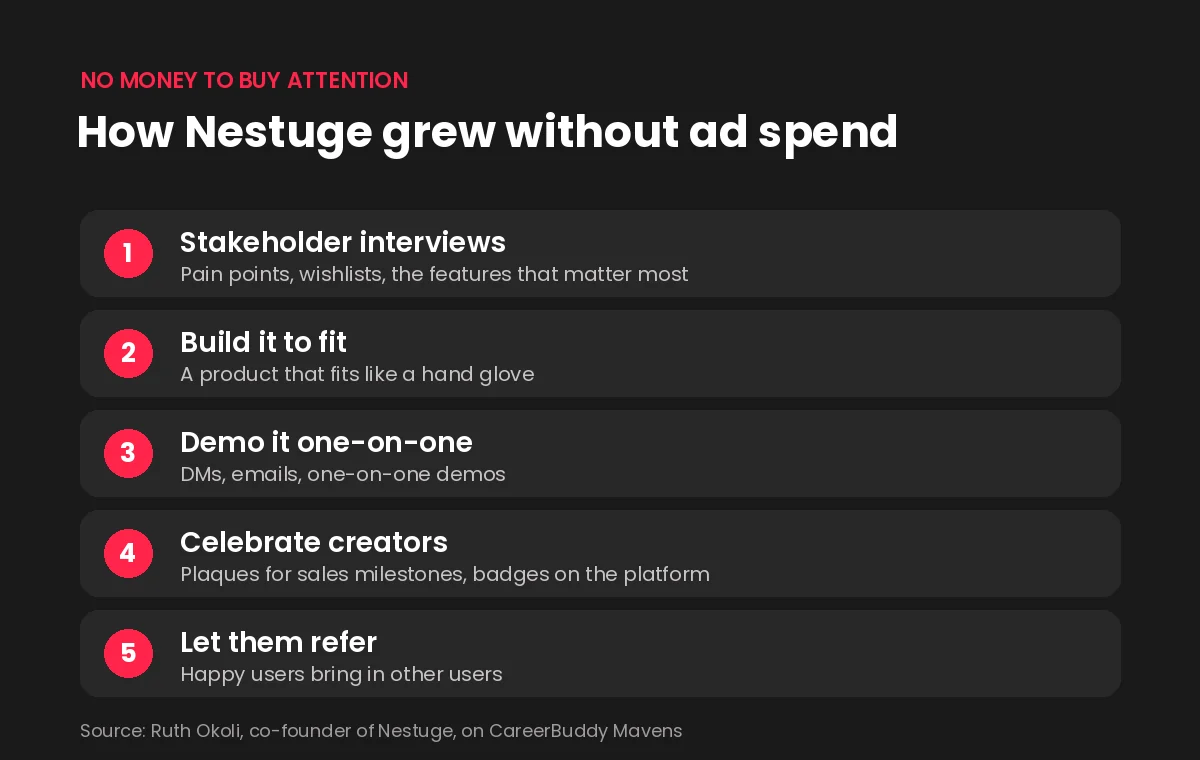
As Co-Founder of Nestuge, an innovative platform that helps creators, educators, and working professionals build, scale, and monetize their digital products, Ruth Okoli turned a business analysis training course into a co-founder seat at a high-growth tech startup. Under her strategic leadership, Nestuge scaled organically without reliance on heavy external venture capital, driving acquisition through deep customer empathy, product quality, and community recognition.
In this edition of CareerBuddy Mavens, Ruth shares her personal playbook on pivoting into tech without abandoning your safety net, packaging five or more years of workplace experience into scalable digital assets, avoiding the major sales traps that trip up corporate experts, and marketing a product successfully when you cannot afford to buy attention.
Upskilling Before Pivoting: The Reality of Tech Transitions
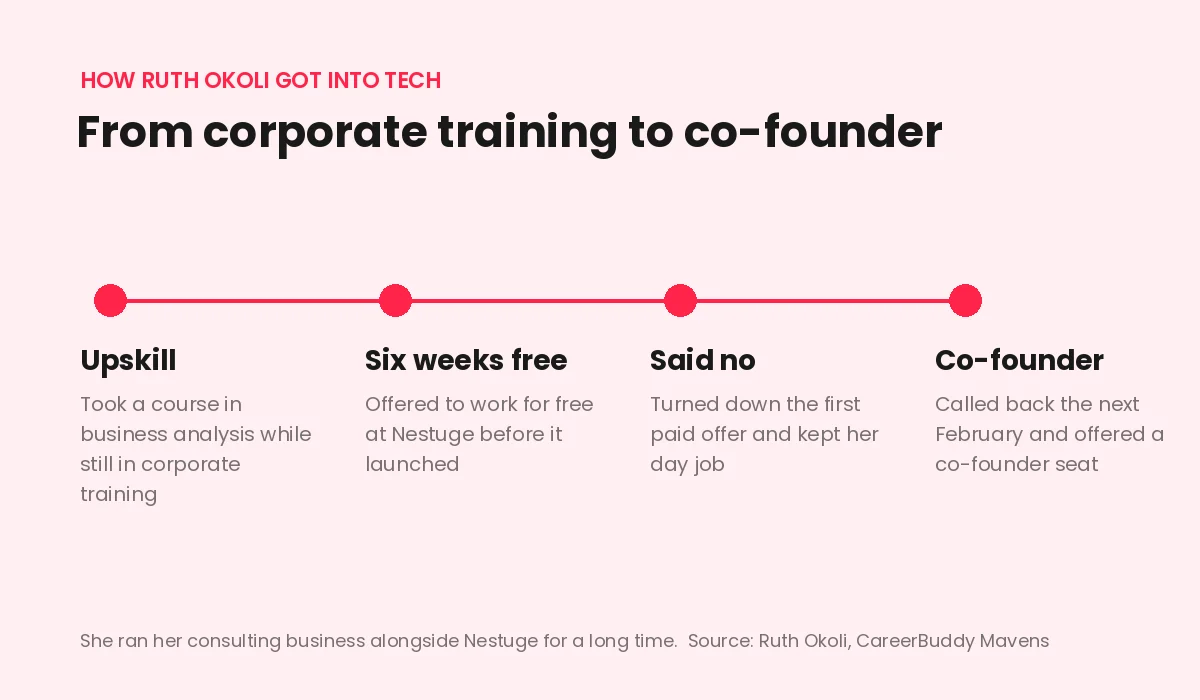
Nothing necessarily made me move from consulting and corporate training to co-founding Nestuge. I wasn't waking up every day with a grand plan to quit my job. I was actually just looking to upskill in consulting, so I took a course in business analysis.
Then, I was still doing learning and development, training corporate teams. I was not necessarily doing core strategy or management consulting yet. I wanted to become better for myself, so I enrolled in that course. That single course is what naturally led me into tech.
While attempting to upskill and learn more, I started looking out for places to intern and apply what I was learning. I found Nestuge. At the time, they were just building; they had not launched yet.
A friend of mine who used to work there told me they were looking for someone in the business development team to come sell the market and whatnot. I reached out directly and said, "I'm not in business development. My course is business analysis. But I can actually just come in and see what I can do."
I wanted to work for free for them for like a month to show what I could deliver. It ended up being six weeks.
Core Takeaway: The part of career pivoting that works best has very little to do with dramatic public announcements. It is showing up, delivering output, and letting the quality of your work force the executive conversation.
After the six-week milestone, they offered to pay me to stay. But as at then, they had still not launched. They were still just building, and I said no because the pay was a bit low for where I was.
I told them, "Don't worry, I'll just keep my normal job and my consulting work, and I can come back whenever you guys are ready."
All of this happened around August to September. I left after six weeks. Then, they called me back the next year, in February, and offered me a Co-Founder position based on the quality of work I did during those six weeks.
And then here I am.
So there wasn't a sudden move. It was me trying to upskill, become better for myself, pitch myself for different opportunities, post what I learned online from the course I took, and then finding myself here. I was also still doing my consulting business even then. I didn't necessarily just quit my job—I was doing both for a long time too.
What 5 Years on the Job Actually Prepares You to Sell
If someone has five years in a regular job, what could they realistically package and sell? What does that first product look like?
If you have five years of experience, I consider you a mid-level employee. You are not a beginner, but you are not necessarily an untouchable expert either. And that is completely fine. You shouldn't be trying to package things for senior directors. You can package literally from the beginner level.
Primary Barriers to Knowledge Monetization:
Assuming your first digital product must be a massive 50-hour video curriculum.
Explaining technical processes and tools instead of tangible career outcomes.
Launching publicly without testimonials, reviews, or proof of concept.
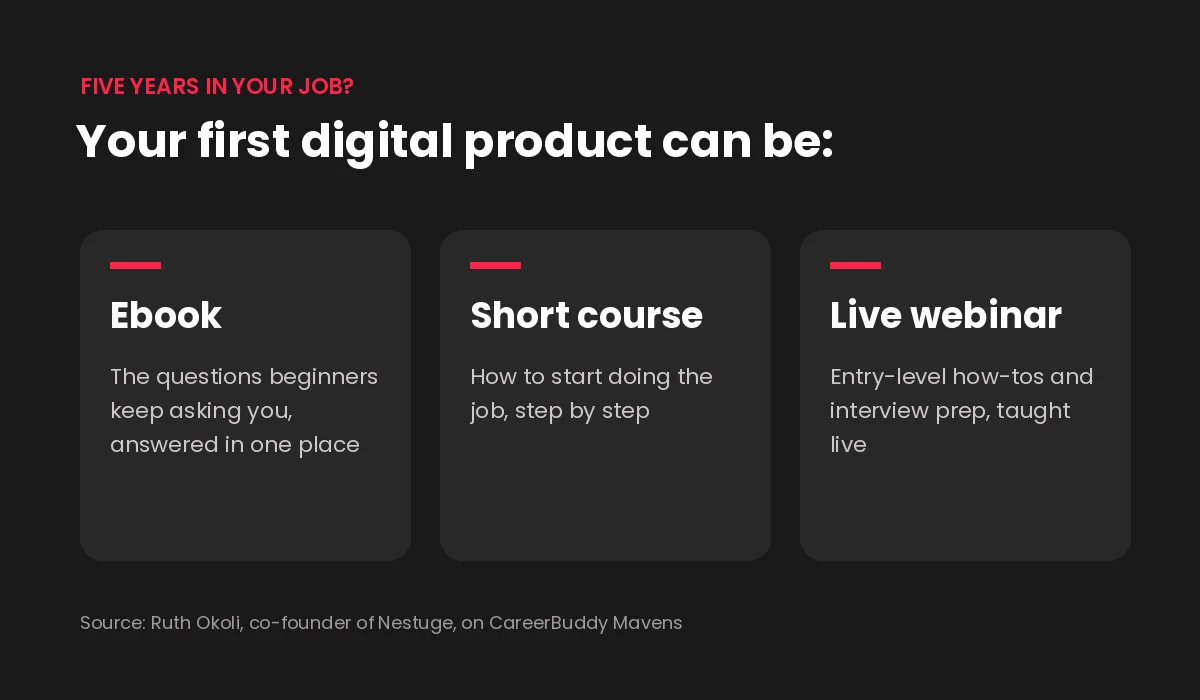
For example, if you are a data analyst and you have five years of experience, you can package how to get into the data analysis industry today. How to find a job in the data analysis business. What skills to master or pack to get into data analysis.
A how-to guide can work. A questions-to-answer or questions-to-prepare-for bank for a data analysis interview. Basically entry-level stuff.
If it's a designer, the same thing: entry-level stuff, and also mid-level too. Maybe some core principles in data analysis that are relevant, or a short course on data analysis to start doing your job. It can be a how-to guide, or it can be a short course on what you should look out for before trying it out.
Keep the initial product format simple and low-friction:
An e-book solving one specific operational problem.
A short, focused entry guide or interview preparation bank.
A live webinar walking through a single workflow.
Those are things that will easily fly for someone that has five years of experience. Not necessarily a long-form, complex course. Just a live webinar or an e-book are things that will work here.
Why Technical Experts Fail at Selling
The most common mistake I see when professionals or creators try to sell is not packaging their value well.
Most professionals already have the value, but this act of selling is very important. People like to buy, but people don't like to be sold to.
When you are selling, you are meant to sell the value. You are meant to sell the experience. You are meant to sell the outcome, not necessarily the features.
Same way iPhone is not selling, "Oh, this camera is three-point whatever sharpness or the battery is whatever voltage." It's telling you how you look beautiful in the pictures. It's telling you the luxury of life that you can afford thanks to the camera, thanks to the phone you're holding in your hand.