Jensen Huang’s Exit at Nvidia Is a Brutal Lesson on Office Politics and Company Stock
Direct Summary: Jensen Huang resigned as Nvidia’s CEO, president, and board member on November 12, 2026, ending a 33-year run. His departure followed a November 8 memo admitting an affair linked to a Singaporean data center executive under U.S. intelligence scrutiny, and a November 11 New York Times report alleging a second relationship with Nvidia VP Kimberly Powell, one of his direct reports. CFO Colette Kress is now interim CEO, Nvidia’s stock has dropped roughly 35% from its October peak, and every employee holding company equity just got a harsh reminder about leadership risk.
Earlier this year, Jensen Huang joked that the secret to surviving as a tech CEO was simple: "don't get fired" and "don't get bored".
On Thursday, November 12, his 33-year streak ended anyway.
Nvidia announced that Huang had stepped down as president, chief executive, and board member, effective immediately. Chief Financial Officer Colette Kress is stepping in as interim CEO while keeping her finance duties, and longtime technology executive and venture investor Harvey C. Jones becomes the board’s first-ever chair. Nvidia’s official press release thanked Huang for his contributions and left out the mess in the boardroom entirely.
Wall Street didn't. And if you work a 9-to-5, especially one that pays you in stock options or answers to complex office hierarchies, you shouldn't ignore it either.
How 33 Years Unraveled in Two Weeks
Date
What Actually Happened
Late October
The New York Times reports that U.S. officials have been investigating Alice Huang (no relation), a former managing director at Megaspeed, a Singapore-based company that buys Nvidia chips, and flags her "close relationship" with Jensen Huang. U.S. intelligence officials reportedly suspect China’s Ministry of State Security recruited her to gather information on him, and the Financial Times reports a U.S. intelligence memo described a romantic relationship. China disputes the espionage claims.
8 November
Huang sends an internal memo to staff: "I was unfaithful to my wife". He names no one. Nvidia’s board appoints independent directors and outside lawyers to investigate, stating it has "no reason to believe that either national security or Nvidia secrets were compromised".
9 November
The Associated Press reports Nvidia is investigating whether Huang was targeted by a "foreign intelligence effort". Shares fall more than 4%, with AP’s headline putting the single-day value drop at $330 billion. President Trump tells reporters he believes Huang had no idea the woman may have been a spy.
11 November
The New York Times reports a second relationship; this time with Kimberly Powell, Nvidia’s vice president of healthcare, who reports directly to Huang. The report cites five people who worked at Nvidia and says the two were seen being affectionate at a San Jose hotel during Nvidia’s March developer conference. Axios reports a bystander recorded the moment and Huang’s security team offered that person a nondisclosure agreement. The Wall Street Journal reports the board is preparing to remove him, with a board meeting running late into the evening.
12 November
Huang resigns. Nvidia shares fall more than 10% from the previous close of $173.73.
Separating Confirmed Facts from Internet Noise
When a company of Nvidia’s scale loses its founder overnight, social media, particularly X, turns into an unfiltered rumor mill. Here is where the reporting actually stands versus what is pure speculation:
What is confirmed and on the record:
The admission and resignation: Huang admitted to infidelity in his November 8 message to employees—which reporting links to Alice Huang—and resigned four days later.
Multiple active inquiries: Nvidia’s independent board investigation is ongoing. Separately, Singapore’s Ministry of Home Affairs confirmed an ongoing investigation into Megaspeed, and three Republican House committee chairs requested a closed-door congressional briefing with Huang (proposed for November 18, though not yet publicly confirmed).
What remains alleged or disputed:
Foreign intelligence recruitment: U.S. officials suspect Alice Huang was recruited by Chinese intelligence. China rejects the allegation, and Singapore states its authorities never investigated her over intelligence links or her reported relationship with Huang.
Export control breaches: Allegations that Megaspeed helped Chinese customers acquire Nvidia chips in breach of U.S. export rules remain unproven, and Megaspeed denies any wrongdoing. Nor has any public finding shown that Nvidia trade secrets were shared.
The Kimberly Powell report: Neither Huang nor Powell has confirmed or denied the New York Times report. When reached by the Times, Huang reportedly said, "I don't think you should be talking to me directly," and ended the call. Whether the San Jose hotel bystander accepted or signed the offered nondisclosure agreement has not been established.
What is unsupported by reporting:
"Hush money" claims: A widely shared post claimed Huang paid hush money. None of the credible reporting describes any payment; what Axios reported was an offer of a nondisclosure agreement to a bystander. Viral posts also labeled the hotel footage "intimate," whereas the Times’ sources described the two as affectionate.
Fabricated CEO stats and firing myths: Another viral post claimed roughly 80% of married male tech CEOs do the same thing without citing a single source. Meanwhile, a long thread on X mapped out what happens to Huang’s shares if the board "fires" him. He wasn't fired; rather, he resigned. While the thread is right that his ~3.56% common stake (making him Nvidia’s largest individual shareholder) remains his, and that he holds no super-voting shares like Mark Zuckerberg at Meta, claims that he plans to launch a proxy fight, start a rival chipmaker, or dump stock to tank the price are pure speculation.
The Financial Damage and Governance Gaps
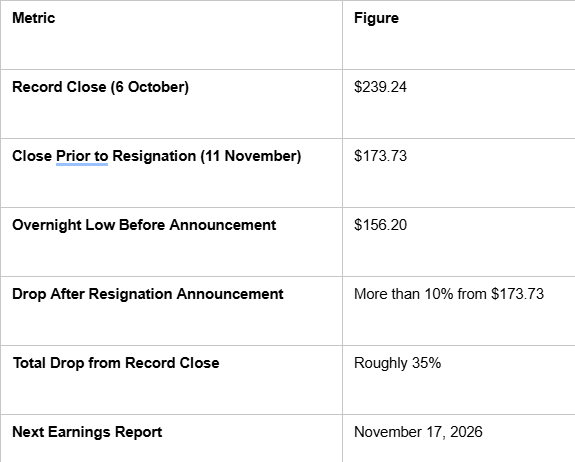
Record Close (6 October)
$239.24
Close Prior to Resignation (11 November)
$173.73
Overnight Low Before Announcement
$156.20
Drop After Resignation Announcement
More than 10% from $173.73
Total Drop from Record Close
Roughly 35%
Next Earnings Report
November 17, 2026
Depending on which day you measure from, the market value erased is staggering. A widely circulated post on November 11 pegged the loss at over $1.7 trillion, while Yahoo Finance’s live coverage calculated the drop from the October record close at roughly $2 trillion at the overnight low, including more than $600 billion lost in the week leading up to the exit.
Wall Street analysts are sharply divided on what Nvidia is worth without its founder:
Bernstein downgraded Nvidia to Market-Perform and cut its price target in half, from $400 to $200.
Baird moved to Neutral.
Wedbush’s Dan Ives had previously modeled a $300 target with Huang at the helm versus $225 if he were ousted—effectively putting a $75-per-share price tag on Huang’s leadership.
Raymond James held its Strong Buy rating, arguing that Nvidia is "more than just its CEO".
The structural concern for investors is that Huang left behind an unusually flat executive layer. According to Fortune, Nvidia has no Chief Operating Officer, no Chief Compliance Officer, roughly 60 executives reporting directly to Huang, and no publicly named successor. As Georgetown professor Jason Schloetzer noted, without a clear succession roadmap, any transition risks becoming "sudden and perhaps forced".
Three Brutal 9-to-5 Lessons from Nvidia’s Meltdown
You don't need to be a Silicon Valley billionaire to feel the lessons from this wreckage. Whether you work in Lagos, Abuja, London, or San Jose, three workplace realities just got underscored:
1. Office romance isn't the corporate crime, but maybe hidden reporting lines are
Every time a CEO gets caught in an office scandal, social media replies fill up with "People meet at work all the time!" True. Corporate HR rarely cares if two peers in separate departments date; most policies simply require a quick disclosure. They do, however, draw a hard line when one person sits in the other's reporting chain and controls appraisals, promotions, and bonuses.
Nvidia’s own code of conduct, as quoted by IBTimes Singapore, instructs employees to avoid conflicts of interest, including "personal relationships" (though no formal policy violation has been established, and Nvidia has not said whether it is investigating the Powell claims). Precedent, however, is unforgiving: in 2018, Intel CEO Brian Krzanich resigned after the board uncovered a past consensual relationship with a subordinate that violated its non-fraternization policy. If you remember, in July 2025, Astronomer’s CEO stepped down after a viral concert video showed him with the company’s Chief People Officer, with the board stating leaders must set the standard for conduct.
If you are involved with someone at work, read your handbook for three things: whether you must disclose, who you disclose to, and whether one of you must transfer teams. Disclosing early keeps the file clean; hiding it until a bystander pulls out a phone hands strangers control of your career.
2. If your compensation includes company stock, your risk is doubled
In August 2024, Fortune reported that Nvidia’s shares had surged over 3,000% since early 2019, turning legions of rank-and-file employees into multimillionaires. Because stock grants typically vest over four years and employees could also buy shares through an employee stock purchase plan at a 15% discount using up to 15% of their salary, Nvidia’s 2023 turnover sat at a microscopic 2.7%, compared to 17.7% across the semiconductor industry.
Today, those exact employees, who played zero role in the executive suite, are holding stock sitting roughly 35% below its record high. When both your monthly paycheck and your unvested equity depend on the same employer, a leadership scandal hits your net worth the same day it hits the headlines.
3. Survive a leadership vacuum by putting everything in writing
With CFO Colette Kress covering the CEO role while maintaining her existing finance responsibilities, one executive is now doing two massive jobs while the board searches internally and externally for a permanent pick. At any company, an interim leadership stretch slows down major sign-offs and puts long-term strategy on pause. Protect yourself during executive transitions by keeping your manager updated in writing on what you own and documenting your project statuses so your work doesn't get lost in the shuffle.
How Workers Are Reading the Room
To capture how everyday professionals are processing the fallout, we asked our readers exactly what they thought about the situation at hand:
Funke*, 36 — HR Manager, Logistics, Lagos
"The very first thing I ask in any workplace relationship is: who reports to who? That is the whole ballgame. If two people in the same department are dating and neither manages the other, most companies ask them to tell HR and leave it there. The moment one sits in the other's reporting line, it becomes a serious problem, because the junior person's appraisal, promotion, and bonus depend on someone they're romantically involved with. Nobody in that position can say no freely, and nobody else on the team can trust that decisions are fair.
I’ve seen people argue it's just a work relationship and everyone does it. Sure, people meet at work. What I tell staff is that early disclosure protects both people; HR can quietly move one person to another unit and keep the file clean. Once it leaks through a video or a former colleague, you've lost all control of how the story is told. And honestly, the rule shouldn't get smaller as the title gets bigger. A CEO’s decisions carry way more weight, so fairness matters even more."
Tobi, 29 — Backend Engineer, Fintech
"My stock options are in the company I work for, so I read this story very differently from people just watching the drama. Nvidia employees got rich because the share price climbed for years, and thousands stayed put because their grants hadn't fully vested. Now the stock is down about 35% from its peak, and none of those workers did anything wrong. Some of them are definitely opening their grant portals right now and recalculating what their shares are worth.
I read a viral thread saying a CEO’s personal conduct doesn't matter as long as he doubles revenue. I completely disagree, because the market clearly doesn't separate the two. The stock sold off on the headlines before anyone even knew if trade secrets were touched. You can call that unfair, but that's how prices move. My biggest takeaway is a simple personal audit: my salary and my equity depend on the exact same employer. If leadership implodes at the top, I get hit from both sides at once."
Amaka, 41 — Finance Manager (holds U.S. tech shares)
"My first reaction was identical to half the replies on X: it’s his private life, why should I care? Then I saw Nvidia sliding, and realized if I had invested in NVIDIA, it would affect my money directly.
What really shifted my view was reading that the board brought in outside lawyers to investigate whether he was targeted by a foreign intelligence effort. That isn't tabloid gossip. If a company's CEO may have been approached by another country's intelligence service, the board has a fiduciary duty to investigate regardless of anyone's opinion on his marriage. Then came the second report involving someone reporting directly to him. Suddenly there are two distinct risks: a national security question, and whether the CEO followed the same rules enforced on junior staff. I want to hear what Kress and the board say on the November 17 earnings call. But I’m done pretending a CEO’s personal discipline is separate from the stock I buy."
Ifeanyi, 27 — Operations Associate, Consulting firm
"Sitting on the junior side of an org chart, I read the Powell allegation very differently. She is reported to be one of roughly 60 people reporting straight to him. If that report is true, how do you say no to the person at the absolute top of the company, or report it to anyone internally? People keep saying relationships at work are normal, and I agree, but when the power gap is that extreme, calling it an equal choice feels complicated.
At the same time, nothing has been proven. Neither she nor Huang has commented publicly, so I’m not jumping to conclusions about her. What I am doing is checking how my own company handles workplace disclosures, because I’ve never actually read our handbook. It also makes me think about how Bill Clinton survived his own scandal, and if a president can survive that, maybe Nvidia should have kept Huang. Then on second thought, there's also the fact that the comparison doesn't even correlate because Clinton wasn't answering to a corporate board obligated to prove to shareholders that it enforces its own rules."
What Happens Next?
Mark two dates on your calendar: November 17, when Nvidia reports earnings under interim CEO Colette Kress, and November 18, the proposed date for Huang’s closed-door congressional briefing. Meanwhile, the board’s independent security probe continues as Nvidia weighs both internal and external candidates for a permanent CEO. Until those answers land, expect heavy market swings.
(Note: If you hold U.S. tech stocks via local investment apps, treat this as market context, not investment advice.)
FAQ
Why did Jensen Huang resign as Nvidia CEO?
Jensen Huang resigned on November 12, 2026, effective immediately, four days after sending an internal memo admitting to an affair amid an independent board investigation into his ties to a Singaporean executive, and one day after The New York Times alleged a second relationship with Nvidia VP Kimberly Powell.
Who is the new CEO of Nvidia?
Nvidia Chief Financial Officer Colette Kress was appointed interim CEO on November 12, 2026, while the board considers internal and external candidates for a permanent replacement.
Who are Alice Huang and Kimberly Powell?
Alice Huang is a former managing director at Singapore-based Megaspeed whom U.S. intelligence officials suspect was recruited by Chinese intelligence (a claim China denies). Kimberly Powell is Nvidia's vice president of healthcare, who reports directly to Huang and was named in a November 11 New York Times report alleging an affair.
Did Jensen Huang pay hush money?
No credible reporting describes a payment. Axios reported that Huang's security team offered a nondisclosure agreement (NDA) to a bystander after filming him with an executive in March 2026, though whether it was accepted has not been established.
Related: From Teammate to Boss: The First-Time Manager's 90-Day Playbook (Africa Edition, 2026)